
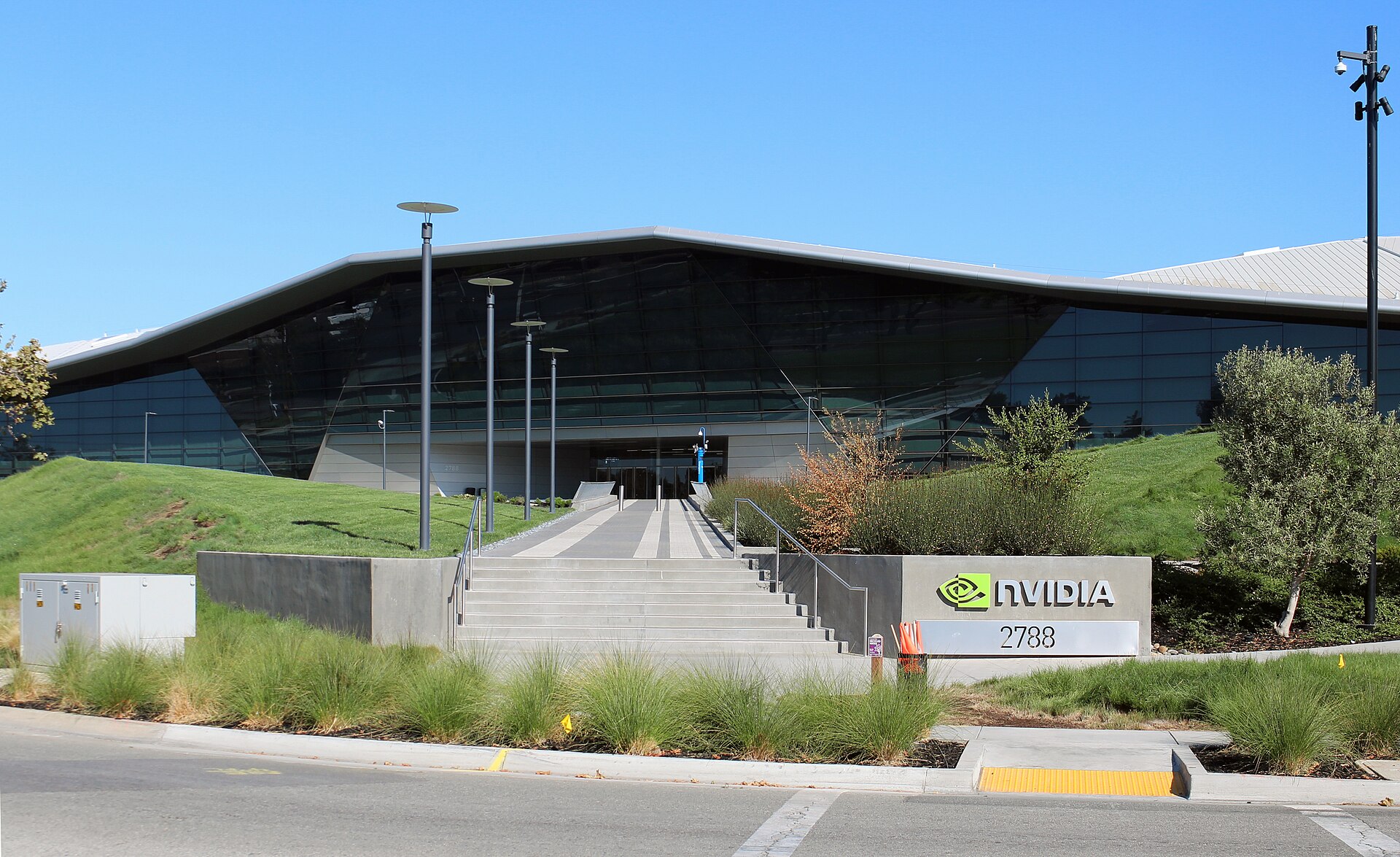
NVIDIA (NVDA) is the chipmaker that went from video games to the center of the AI boom. Our daily price data for NVDA starts on January 22, 1999 — and the story since then is a tour of American business history.
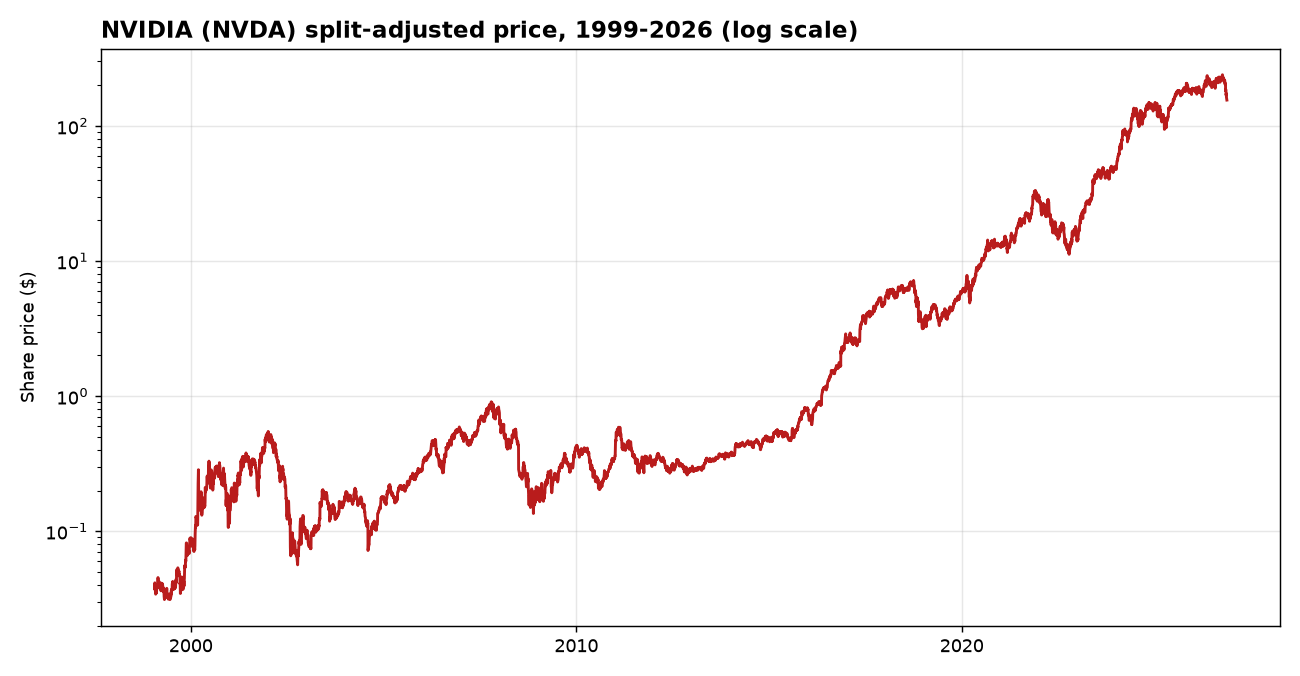
On price alone, $1,000 became about $4,134,574. With dividends reinvested, it became $4,342,582 — the dividends contributed roughly $208,008.
The price, decade by decade
| Year (start of year) | Split-adjusted share price |
|---|---|
| 1999 | $0.0376 |
| 2009 | $0.1997 |
| 2019 | $3.38 |
The worst fall
The deepest drawdown in the data ran from January 03, 2002 to October 09, 2002: -89.7% from peak to trough. Every long-lived company has a fall like that in its past. The ones that survive it are the ones that become the stories we tell.
The story
NVIDIA (NVDA) was founded on April 5, 1993, by Jensen Huang, Chris Malachowsky, and Curtis Priem — the three had sketched out the idea the year before at a Denny’s roadside diner in San Jose. The company made graphics chips for video games, and in 1999 it released the GeForce 256, the first product ever marketed as a GPU.
NVIDIA went public on January 22, 1999 — the day our price data starts. In the early-to-mid 2000s the company invested over a billion dollars to develop CUDA, software that let its gaming chips run general-purpose computing. At the time it looked like a side project for scientists. Two decades later it became the reason NVIDIA’s chips power the AI boom — and the stock’s wildest years (down 82.8% in 2002, up 239.0% in 2023, both total returns) trace that arc.
Today NVIDIA is the world’s most valuable chipmaker, and in 2025 it became the first company ever to pass $4 trillion — and then $5 trillion — in market value, driven by demand for its AI data-center hardware. The gaming chip became the engine of the AI age.
The CEO
Jensen Huang co-founded Nvidia in 1993 and led it for 33 years, turning a graphics-chip startup into the company at the centre of the AI boom. On November 12, 2026, he resigned as CEO; CFO Colette Kress took over as interim CEO while the board searches for a permanent successor.
The products
GeForce 256 (1999). Announced in August 1999 and released that October, the GeForce 256 was the first product ever marketed as a GPU — a graphics processing unit. It turned Nvidia from a PC-graphics supplier into the company that defined 3D graphics, and the GeForce line still carries the brand today.
CUDA (2007). Nvidia created CUDA in 2004 and released it in 2007. It lets programmers run general computing on graphics chips — and it is the reason the same chips that render games turned out to be perfect for training AI models. CUDA is the moat behind the AI boom: rivals can build chips, but the software world runs on CUDA.