
Apple (AAPL) in 1984 was the company that had just launched the Macintosh with the most famous Super Bowl ad ever made. It was also a company drifting toward chaos: Steve Jobs would be pushed out the next year, and the stock would spend the next decade going mostly sideways and down.
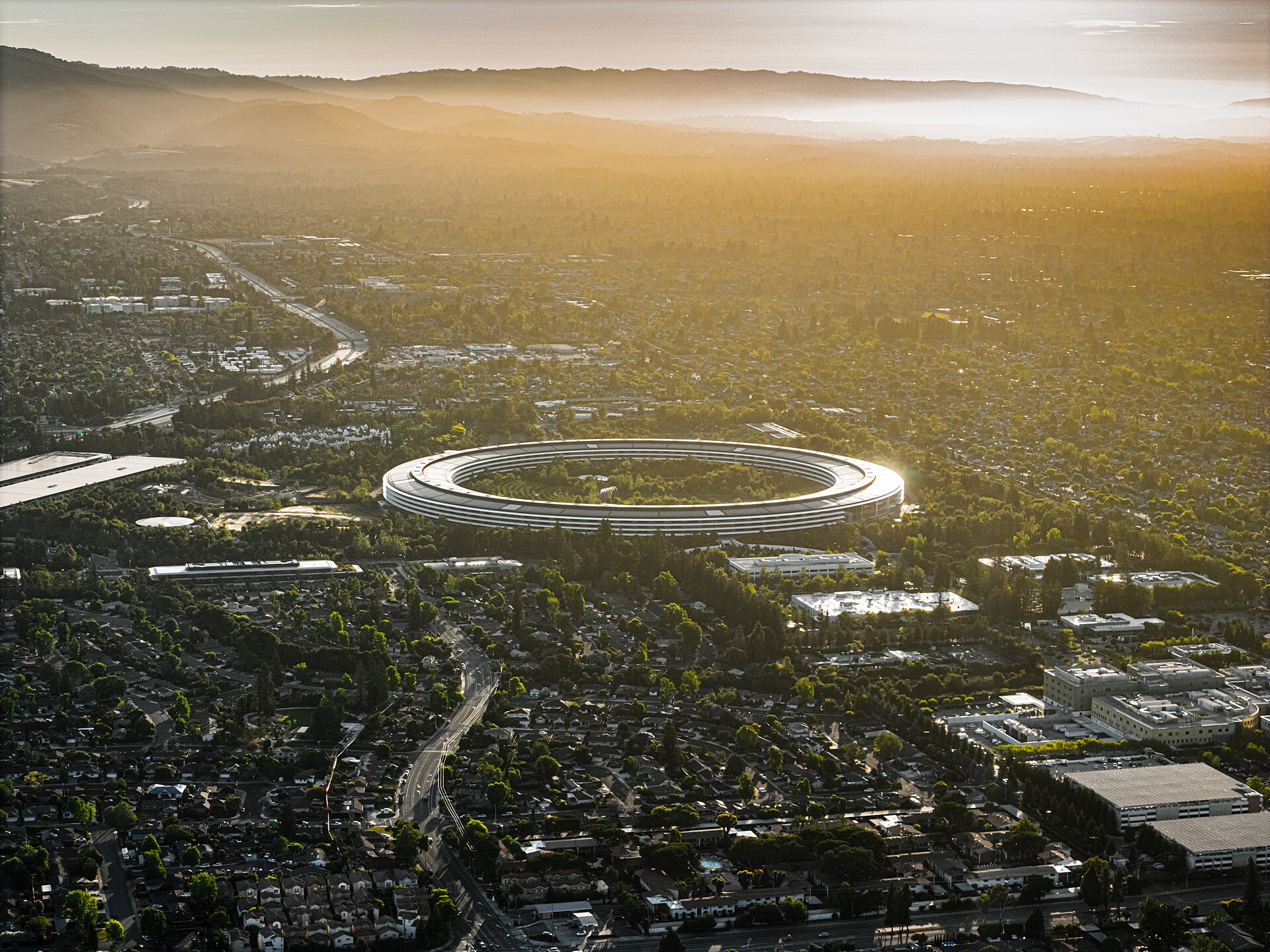
If you had put $1,000 into Apple in late 1984 — our price data starts on September 7, 1984 — and held it until today, here is the result:
That is a return of 403,770%, roughly 22% compounded every year for 42 years. It is one of the greatest wealth-creation runs in market history. It is also a story that almost nobody actually lived, because to collect it you had to survive the part where the company nearly died.
The story
Apple (AAPL) was founded in 1976 as Apple Computer Company by Steve Jobs, Steve Wozniak, and Ronald Wayne. The Apple II, launched in 1977, made it one of the first successful personal computer companies, and on December 12, 1980, Apple went public on the Nasdaq.
The Macintosh followed in 1984 — the machine this post starts with. By 1985, internal conflicts had pushed Jobs out of the company he founded. By 1997 Apple was reporting major losses and struggling to ship a modern operating system; it bought Jobs’s company NeXT, which brought him back — and in August 1997 Jobs secured a $150 million investment from Microsoft. The stock still fell 37% that year on price alone, then rose 212% in 1998.
The iPod (2001), the iPhone (2007), and the iPad (2010) turned Apple into a consumer-electronics company — it dropped “Computer” from its name in 2007. Tim Cook took over as CEO in 2011, the year Jobs died. Apple became the first publicly traded U.S. company valued at over $1 trillion in 2018, and today it is one of the most valuable companies on earth. The iPhone year, 2007, rose 134% on price alone.
The lost decade (1984–1997)
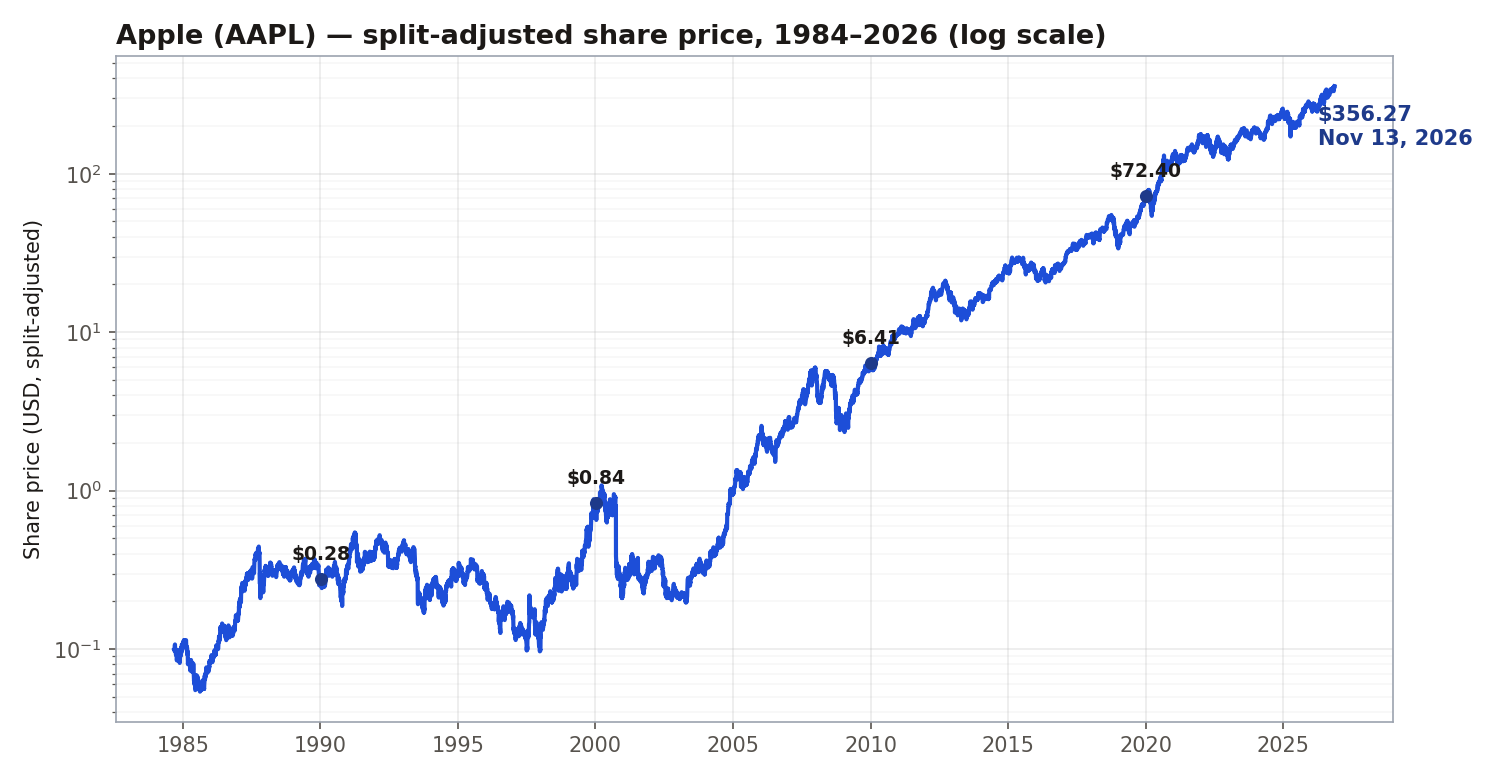
Apple’s first decade as a public company after 1984 was miserable for shareholders:
| Year | Share price* | $1,000 became* |
|---|---|---|
| 1984 | $0.10 | $1,000 |
| 1990 | $0.28 | $2,811 |
| 2000 | $0.84 | $8,451 |
| 2010 | $6.41 | $64,641 |
| 2020 | $72.40 | $729,845 |
| Nov 2026 | $356.27 | $3,591,431 |
*Split-adjusted price path from our database; the true total with all dividends reinvested is higher (see methodology).
By 1997, Apple was 90 days from bankruptcy by some accounts. The stock fell 56% between August and December 1997 alone. In August 1997, Microsoft — Apple’s great rival — invested $150 million to keep Apple alive, and Steve Jobs returned as interim CEO. Investors who bought in 1984 had waited 13 years and were sitting on roughly $1,000 of value for their $1,000. Thirteen years, zero gain, one near-death experience.
Then everything changed — twice
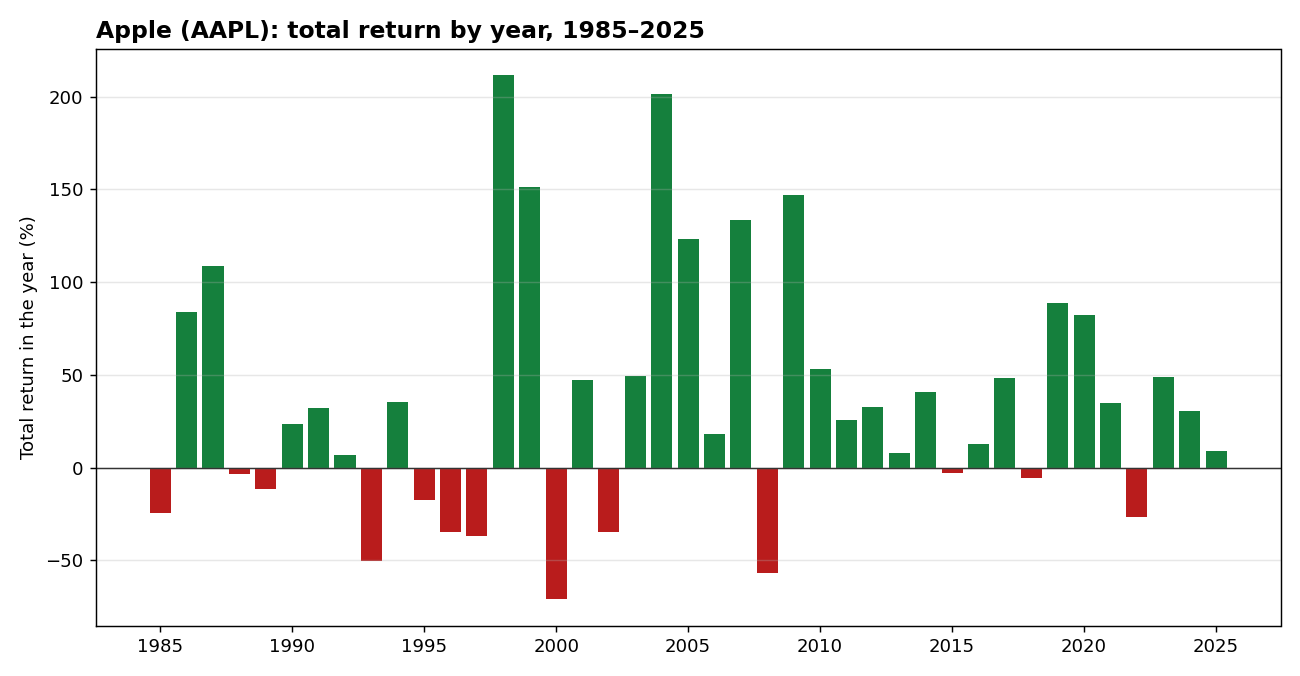
Apple’s annual returns tell the story in one glance. The best year ever was 1998 (+212%), the year after Jobs returned. The worst was 2000 (−71%), when the dot-com crash cut the stock by almost three quarters. Since 1981, Apple has risen about 19% a year on average — but the average hides years of +212% and −71% sitting side by side.
The real inflection came in two waves:
- 2001–2007: the iPod and the iPhone. The iPod (2001) made Apple a consumer company again; the iPhone (2007) made it the most valuable company on earth. The stock rose 201% in 2004 and 133% in 2007.
- 2010–2026: the compounding machine. Once the iPhone became a platform — App Store, services, wearables — the growth turned steady. From $6.41 at the start of 2010 to $356.27 in November 2026, the stock rose more than 55-fold in 17 years.
What about buying at the IPO?
Apple went public on December 12, 1980, at $22 a share. Here is a surprise: buying at the IPO worked out worse than buying in late 1984. The total return since the IPO is about +363,441% — $1,000 became roughly $3.63 million — slightly less than the $4.04 million from a December 1984 start. The stock spent its first four public years falling, so the patient 1984 buyer started from a lower base.
That is a useful reminder: the starting price matters enormously, and “buy the IPO” is not automatically the best version of a great story.
Apple by the numbers
All figures below are price-only, computed from our daily price data (1984–2025) — dividends excluded, so the true total returns were higher.
- 42 calendar years in the data; the stock rose in 29 of them (69%).
- Best year: 1998, +212% on price alone. Worst year: 2000, −71% — the dot-com crash.
- Worst single day: September 29, 2000, −52%. Best single day: August 6, 1997, +33%.
- Nearly a third of its years were down — including the year it nearly died. Holding through them was the whole trade.
The CEO
Steve Jobs is the only person who has run Apple twice. He co-founded the company in 1976, was pushed out in 1985, and came back in 1997 when Apple bought his company NeXT — and built the iPhone era that this post is about.
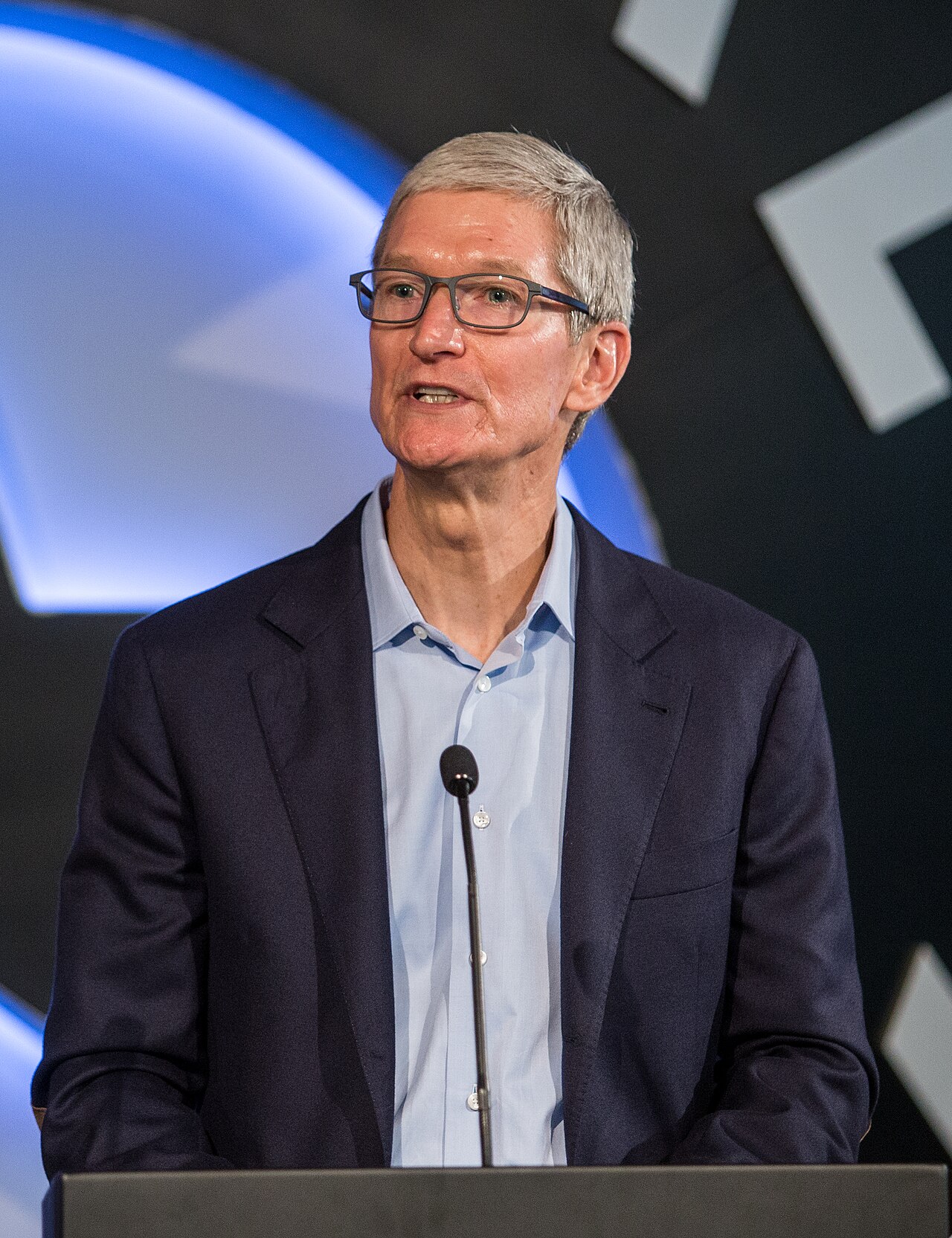
Tim Cook joined Apple in 1998 as senior vice president for worldwide operations, became chief operating officer under Jobs, and took over as chief executive in August 2011, when Jobs resigned. He led Apple for fifteen years, into the ranks of the world’s most valuable companies, and stepped down as CEO on August 31, 2026. He is now executive chairman.
The chief executive today is John Ternus, who took over on September 1, 2026. He has been at Apple since 2001 and was senior vice president of hardware engineering from 2021 to 2026; Apple credits him with work on the iPad and AirPods and with overseeing the move from Intel processors to Apple silicon in Mac computers.
The products
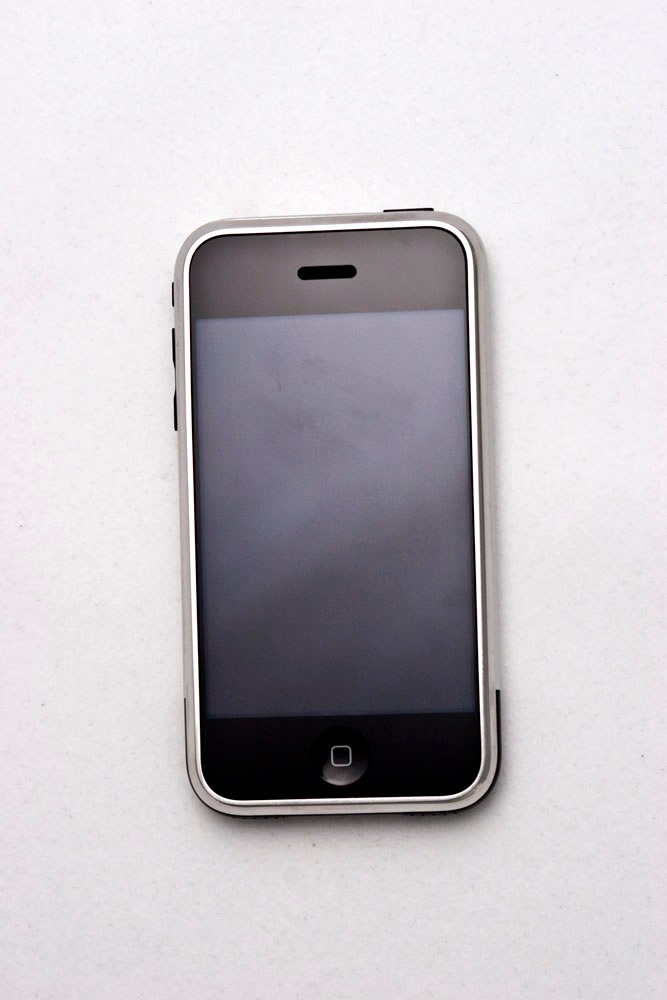
Three products turned Apple from a computer company into the company in this post.
Mac (1984). The original Macintosh launched in January 1984 — the machine this post starts with. Macs have been in Apple’s lineup ever since.
iPod (2001). Released on November 10, 2001, it put a thousand songs in a pocket and made Apple a consumer-electronics company. About 450 million iPods were sold before the line was discontinued in May 2022, after more than twenty years.
iPhone (2007). Announced by Steve Jobs on January 9, 2007 and launched that June. More than three billion iPhones have been sold, and Apple has been the world’s largest phone vendor since 2023.
Who owns it
No single person controls Apple. Its largest owners are the index funds, and the most famous name on the register owns less than 2%.
| Largest holders | Shares | Share of the company |
|---|---|---|
| Vanguard Group | ~1.40 billion | ~9.5% |
| BlackRock | 1.16 billion | 8.0% |
| State Street | 597.5 million | ~4.1% |
| Berkshire Hathaway (Warren Buffett) | 227.9 million | 1.6% |
Vanguard and BlackRock hold Apple mostly through index funds: they own it because it is one of the largest weights in the S&P 500, not because a manager picked the stock. Berkshire Hathaway’s 227.9 million shares are still its largest single stock holding — but only a fraction of the stake it held in early 2024. Berkshire sold about 75% of its Apple position across 2024 and 2025. All of Apple’s officers and directors together own about 0.06% of the company.
Source: SEC Form 13F filings, positions as of June 30, 2026 (Vanguard’s total combines its advisers’ filings). Holdings move every quarter — this is a snapshot of one moment, not a permanent fact.
The catch (there is always one)
Three honest caveats, before anyone gets carried away:
- Survivorship bias. We are telling Apple’s story because Apple survived. For every Apple, there were dozens of 1980s computer companies — Osborne, Commodore, Wang — that went to zero. Picking the survivor in advance was the hard part.
- Nobody held perfectly. The 22%-a-year figure assumes you never sold, never panicked in 1997, 2000 (−71%), 2008 (−57%) or 2022 (−26%), and reinvested every dividend. Real humans almost never do that.
- The future is not 1984. Apple is now a $5 trillion company. It cannot compound at 22% a year for another 42 years — that would make it worth more than the entire world economy several times over.
Apple’s story is not a prediction. It is proof of what long holding periods can do when a business transforms itself — and proof of how much patience that transformation demands.